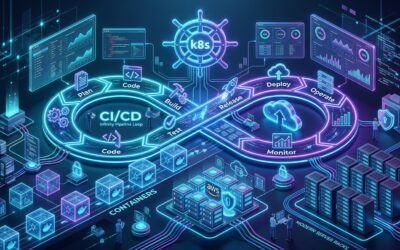
In 2026, cloud computing and enterprise software delivery have definitively converged around a single architectural standard: cloud-native container orchestration powered by Kubernetes (K8s) and automated GitOps workflows. What began a decade ago as a complex container clustering experiment has evolved into the operating system of the global cloud, powering everything from microservice backends and global banking networks to large-scale distributed AI inference pipelines.
However, running Kubernetes in production in 2026 looks radically different from the manual, imperative cluster configurations of the past. Modern Site Reliability Engineers (SREs) and DevOps architects no longer run ad-hoc kubectl apply commands from local terminals. Instead, enterprise organizations operate declarative, zero-trust GitOps pipelines governed by ArgoCD, Helm v3/v4 package managers, dynamic autoscalers (Karpenter / KEDA), and automated service meshes that deliver zero-downtime canary deployments with cryptographic audit trails.
For cloud engineers, system administrators, and developers looking to command top-tier compensation through DevOps Training in Chennai, mastering modern Kubernetes and GitOps architecture is the single highest-ROI technical skill of 2026. In this comprehensive guide, we dissect the internal mechanics of Kubernetes production clusters, compare Helm versus Kustomize packaging, build a declarative GitOps pipeline with ArgoCD, examine cloud-native security paradigms, and provide an actionable career roadmap.
The Evolution of DevOps: Imperative Scripts to Declarative GitOps
To understand why modern enterprises invest heavily in cloud-native platforms, it is crucial to analyze the shift from traditional imperative scripting to declarative state reconciliation:
| Operational Area | Traditional DevOps (CI/CD Push Model) | Cloud-Native GitOps (Pull Reconciler Model – 2026) |
|---|---|---|
| Source of Truth | Dispersed across Jenkins scripts, Terraform state files, and manual CLI commands. | A single, version-controlled Git repository declaring the desired state of all environments. |
| Deployment Mechanism | Push-based: External CI server requires elevated cluster credentials to push manifests into the cluster. | Pull-based: In-cluster operator (ArgoCD or Flux) continuously watches Git and pulls changes autonomously. |
| Drift Detection & Remediation | Configuration drift goes unnoticed until an outage occurs; manual troubleshooting required. | Continuous reconciliation loop detects drift within seconds and automatically self-heals cluster state. |
| Security & Secrets | Long-lived admin kubeconfig credentials stored inside external CI/CD runner environments. | Zero external cluster access required; short-lived workload identities, OIDC tokens, and SealedSecrets / External Secrets Operator. |
| Rollback Strategy | Running custom rollback deployment pipelines; often error-prone during live production emergencies. | Single git revert command instantly restores previous verified cluster state across multi-region nodes. |
| Application Packaging | Proliferation of raw, unversioned YAML manifests copied across development, staging, and production. | Modular Helm Charts and Kustomize overlays parameterized with environment-specific values. |
Core Production Architecture of a Kubernetes Cluster
Production Kubernetes in 2026 separates concerns into the Control Plane (brain) and Worker Nodes (muscle). Understanding how these components communicate via TLS-encrypted gRPC ensures you can diagnose latency and node failures under heavy load.
1. The Control Plane: State, Scheduling, and Reconciliation
- kube-apiserver: The central REST and gRPC gateway of the cluster. Every component, from worker kubelets to external ingress controllers, communicates solely with the API server. It enforces authentication, webhook validation, and RBAC authorization.
- etcd: A high-performance, distributed key-value store that acts as the single source of truth for the entire cluster state. In enterprise deployments, etcd is clustered across an odd number of nodes (3 or 5) with dedicated SSD IOPS to prevent quorum loss.
- kube-scheduler: Intelligently assigns unscheduled Pods to optimal Worker Nodes based on resource requests/limits, affinity/anti-affinity rules, taints and tolerations, and topological spread constraints.
- kube-controller-manager: Runs core control loops including the Node Controller, ReplicaSet Controller, EndpointSlice Controller, and ServiceAccount Controller, continually driving the actual state toward the desired state.
2. Worker Nodes: Workload Execution and Networking
- kubelet: The node agent that ensures containers described in PodSpecs are running and healthy via the Container Runtime Interface (CRI), predominantly containerd.
- kube-proxy: Manages IP virtual server (IPVS) or eBPF (Cilium) routing rules on host nodes, routing cluster-internal traffic across dynamic Pod IP addresses with sub-millisecond overhead.
- Container Network Interface (CNI): Modern clusters have largely transitioned from basic overlay networks (Flannel) to advanced eBPF-powered CNIs like Cilium, which eliminate iptables bottlenecks and provide kernel-level observability.
Packaging Applications: Helm Charts vs. Kustomize
Managing raw YAML manifests across hundreds of microservices quickly becomes unmaintainable. Modern DevOps engineers leverage two primary packaging tools, often combining them in production pipelines.
| Feature / Metric | Helm v3/v4 | Kustomize |
|---|---|---|
| Paradigm | Templating engine using Go templates with variable parameter injection (values.yaml). | Template-free patch engine using base manifests and environment overlays (kustomization.yaml). |
| Versioning & Artifacts | Packages applications into versioned .tgz charts distributed via OCI-compliant registries (ECR, Harbor, Artifact Registry). | Pure Git-based file tree; manifests stay plain YAML without packaging steps. |
| Dependency Management | Built-in chart sub-dependencies (e.g. including Redis or PostgreSQL as child charts). | Requires referencing external Git repositories or local directory paths. |
| Ideal Production Use Case | Third-party vendor applications, reusable enterprise service blueprints, multi-tenant charts. | Fine-grained internal microservice customization across dev/staging/prod environments without template syntax bugs. |
Step-by-Step Production Blueprint: Implementing GitOps with ArgoCD
Let’s build a real-world declarative GitOps continuous delivery workflow. In this model, developers commit code, GitHub Actions builds and scans the container image, and ArgoCD reconciles the deployment inside Kubernetes.
Step 1: The GitOps Directory Structure
Enterprise teams maintain a dedicated configuration repository separated from application source code. This enforces strict separation between application testing and deployment authority:
gitops-manifests/
├── apps/
│   ├── api-gateway/
│   │   ├── base/
│   │   │   ├── deployment.yaml
│   │   │   ├── service.yaml
│   │   │   └── kustomization.yaml
│   │   └── overlays/
│   │       ├── staging/
│   │       └── production/
├── infrastructure/
│   ├── cert-manager/
│   ├── ingress-nginx/
│   └── prometheus-stack/
└── argocd-apps/
    ├── staging-root-app.yaml
    └── prod-root-app.yaml
Step 2: Defining the ArgoCD Application Manifest
ArgoCD uses Custom Resource Definitions (CRDs) to track the relationship between a Git repository and a target cluster namespace:
apiVersion: argoproj.io/v1alpha1
kind: Application
metadata:
  name: api-gateway-production
  namespace: argocd
  finalizers:
    - resources-finalizer.argocd.argoproj.io
spec:
  project: default
  source:
    repoURL: 'https://github.com/enterprise-org/gitops-manifests.git'
    targetRevision: main
    path: apps/api-gateway/overlays/production
  destination:
    server: 'https://kubernetes.default.svc'
    namespace: production-workloads
  syncPolicy:
    automated:
      prune: true
      selfHeal: true
    syncOptions:
      - CreateNamespace=true
      - ApplyOutOfSyncOnly=true
    retry:
      limit: 5
      backoff:
        duration: 5s
        factor: 2
        maxDuration: 3m
Step 3: Zero-Downtime Deployment Strategies in Kubernetes
Production environments cannot tolerate maintenance windows. In 2026, two deployment strategies dominate high-availability architectures:
- Canary Deployments with Argo Rollouts: Routing 5% of incoming user traffic to the newly deployed container version. Automated analysis templates query Prometheus metrics; if error rates remain below 0.1% and latency p99 is under 150ms, traffic scales to 25%, 50%, and finally 100%. If anomalies are detected, the deployment rolls back automatically without human intervention.
- Blue/Green Deployments: Running identical standby and active environments side-by-side. The Service selector flips atomically once full automated integration and sanity tests pass.
Enterprise Cloud Integration: AWS EKS & Managed Infrastructure
While bare-metal Kubernetes is prevalent in private clouds, the vast majority of enterprise production clusters run on managed cloud hyperscalers like Amazon Web Services (AWS EKS). Integrating Kubernetes with modern cloud services learned in our AWS Training in Chennai gives engineers complete end-to-end control:
- AWS Karpenter Autoscaling: Modern EKS clusters have replaced legacy Kubernetes Cluster Autoscaler with Karpenter. Karpenter watches unschedulable Pods and provisions right-sized, spot and on-demand EC2 compute instances directly in under 45 seconds, reducing cloud bills by up to 40%.
- IAM Roles for Service Accounts (IRSA & EKS Pod Identities): Eliminates hardcoded AWS access keys inside containers. Pods assume temporary, least-privilege IAM roles dynamically via OpenID Connect (OIDC).
- AWS Load Balancer Controller: Automatically provisions and configures Application Load Balancers (ALB) and Network Load Balancers (NLB) based on Kubernetes Ingress and Service manifests.
DevOps & Kubernetes Career Landscape in 2026
The demand for certified, hands-on Kubernetes engineers, Platform Engineers, and DevSecOps specialists has reached an all-time high. Organizations across Chennai, Bangalore, Hyderabad, and global tech hubs actively recruit engineers who possess verifiable production clustering experience.
| DevOps Role | Primary Focus | Certifications Valued | Average Salary (India – 2026) |
|---|---|---|---|
| DevOps Engineer | CI/CD pipelines, Docker containerization, Kubernetes operations, cloud infrastructure. | CKA, AWS Certified DevOps Pro | ₹8 – ₹16 Lakhs |
| Site Reliability Engineer (SRE) | System reliability, SLO/SLA management, observability (Prometheus/Grafana/OpenTelemetry), incident response. | CKA, CKS | ₹12 – ₹24 Lakhs |
| Cloud Platform Engineer | Internal Developer Platforms (IDP), GitOps architecture, Crossplane, developer self-service tooling. | CKAD, AWS Solutions Architect | ₹15 – ₹28 Lakhs |
| DevSecOps Architect | Container vulnerability scanning (Trivy), runtime security (Falco), policy engines (Kyverno/OPA Gatekeeper). | CKS (Certified K8s Security) | ₹18 – ₹35+ Lakhs |
Frequently Asked Questions (FAQs)
Is Kubernetes too complex for small and medium businesses in 2026?
While self-managing raw Kubernetes control planes from scratch involves operational overhead, managed cloud services like AWS EKS, Google GKE, and lightweight distributions (K3s) have dramatically simplified day-to-day operations. When combined with declarative GitOps tools like ArgoCD, even small engineering teams can operate production-grade, highly resilient clusters with minimal friction.
What is the difference between Docker and Kubernetes?
Docker is a containerization technology used to package an application and its dependencies into a standardized, portable container image. Kubernetes is a container orchestration platform that manages hundreds or thousands of containerized applications across a cluster of servers, providing automated scheduling, health monitoring, self-healing, scaling, and networking.
Should I learn Docker before learning Kubernetes?
Yes, absolutely. Understanding Dockerfile optimization, multi-stage builds, container image layers, and networking fundamentals is a vital prerequisite before mastering Kubernetes Pod scheduling and cluster architecture.
Conclusion: Master Cloud-Native DevOps at Ampersand Academy
The transition to cloud-native platforms is not a passing trend; it is the foundational architecture of 2026 enterprise computing. Engineers who master Kubernetes, GitOps, CI/CD automation, and cloud infrastructure are positioning themselves at the cutting edge of modern software engineering.
Accelerate your career with industry-leading DevOps Training in Chennai at Ampersand Academy. Our comprehensive curriculum covers Linux internals, Docker, production Kubernetes administration (aligned with CKA/CKAD standards), ArgoCD GitOps, Terraform, and AWS cloud architecture with 100% real-world, hands-on lab infrastructure. Transform your career and become a certified cloud-native architect today.